The new Dictionary of the Spanish Language was released today: the Diccionario de la lengua española (DLE, version 23.8.1). The publisher is the Real Academia Española (RAE). What is special about this edition is not only the new words that have been added. It is also special that the origin of the word algoritmo has been retained in the sense of dust/sand calculation (hisāb al-ghubār). It is the only truly correct etymological explanation of one of the perhaps most important words of all — worldwide!
Do we even need dictionaries in the age of AI? The answer is: yes, absolutely. And ideally also in printed form! Why? Very simply: because with AI, the continuity of word meanings becomes increasingly important. That sounds paradoxical at first, but it has an important background: if you have a physical dictionary, you can be fairly confident even in the future that its content is trustworthy.
Dictionary of the Spanish Language
So, to the new dictionary of the Spanish language. It is the Diccionario de la lengua española (DLE) in version 23.8.1. It was presented to the public on Monday, 15 December 2025. Behind it stands the already mentioned Real Academia Española — the Royal Spanish Academy (RAE). A lot of input also comes from the Asociación de Academias de la Lengua Española (ASALE). The electronic version of the Dictionary of the Spanish Language is already live. The printed version will follow in 2026.
Language institutions like the RAE are naturally conservative. And that is a good thing! Language is the link across generations. Language creates identity and orientation. Yet it also changes again and again. In everyday usage sometimes quickly and implicitly: without any written documentation of what a term means or how it originated.
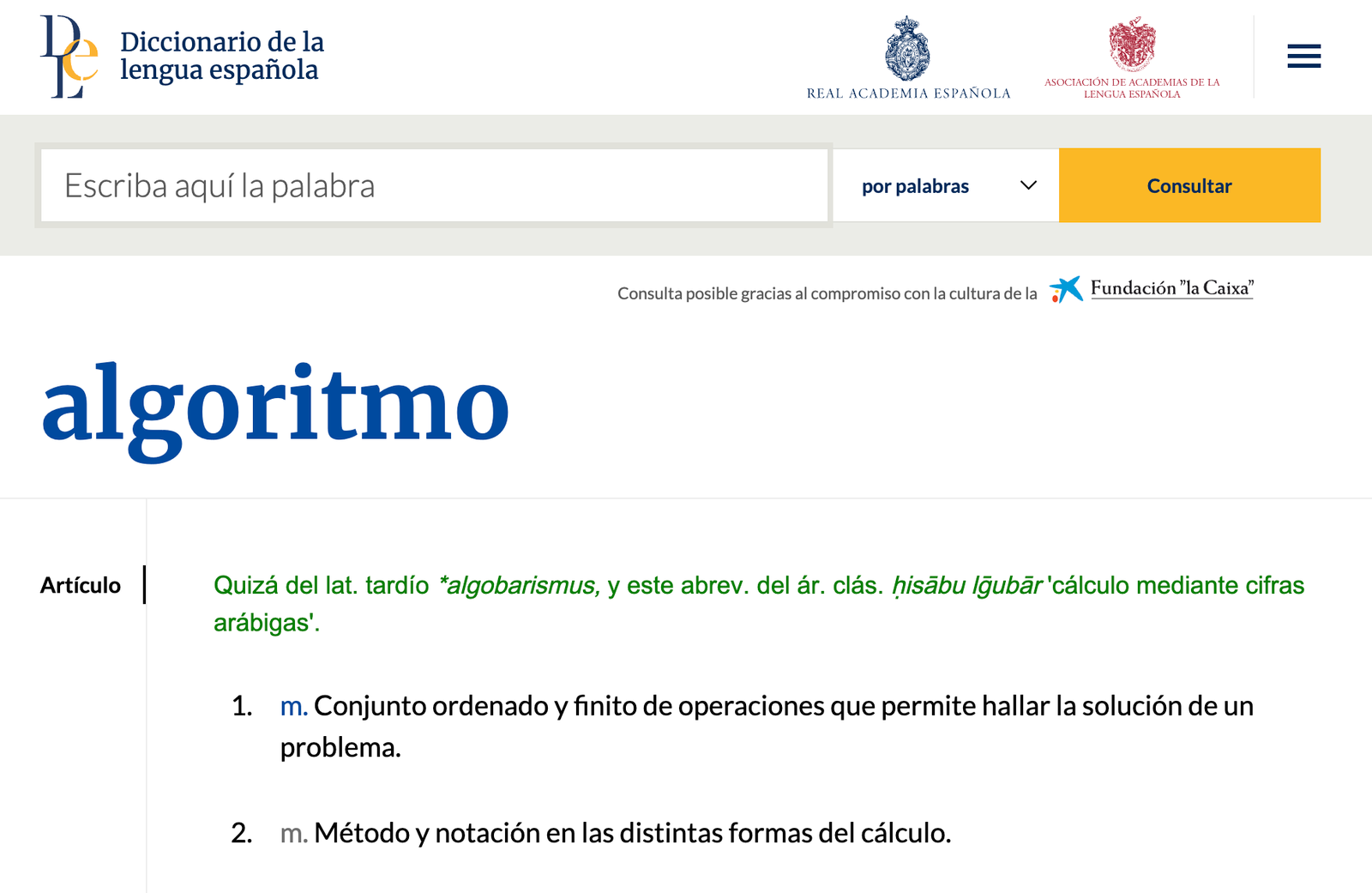
Image source: https://dle.rae.es/algoritmo
The calm eye of the hurricane
The faster the carousel of language spins, the more important a stable anchor becomes: a kind of calm eye of the hurricane that observes and checks where words, idioms and technical terms come from — and where they are going. Etymology, i.e., the origin of terms, matters especially in the digital age because, among other things, globally used social media channels bring more and more foreign-language terms into local linguistic worlds. Everywhere in the world, this repeatedly produces regional neologisms that may be self-explanatory in their regions of origin.
Artificial intelligence also changes language: which German knew the word “prompt” five years ago? Today almost everyone does! But changes also occur through large language models (Large Language Models, LLMs). They sometimes mix terms from different languages unintentionally, among other things through hallucination. So today and in the future it is not only humans who shape language: increasingly, it is also algorithms. And “algorithm” — as the well-known philosopher Yuval Noah Harari has said — may be the most important word in the world.
The etymology of the word “algorithm”
And thus the circle closes with the Dictionary of the Spanish Language, the DLE:
The DLE is the only language lexicon worldwide that for more than 25 years has not explained the word “algorithm” (Spanish algoritmo) with the widely распространенное (almost universally распространённое) al-Khwārizmī eponym.
The latter refers to the etymological derivation of the word via the Latinization of the byname of one of the most historically significant mathematicians of the early Middle Ages: Muhammad al-Khwārizmī.
No question: al-Khwārizmī would indeed be a worthy name-giver for perhaps the most important word in the world. The only problem: the extremely widespread explanation is unfortunately a plausible but merely speculative 19th-century back-projection. Nothing more.
Behind the al-Khwārizmī eponym lies a problem that is becoming ever more relevant precisely in the age of AI: citogenesis, in which one source cites another without having checked the primary sources at all. This creates “felt truths” that continue to spread — and in the end the collective false belief grows ever larger. At the same time, it becomes increasingly impossible to counter the pseudo-legitimation of consensus — the consensus sapientum.
The origin is still Arabic
Against this background it was and is so important that the RAE has maintained in its newest edition the view it has published for more than 25 years: it continues to explain the word algoritmo via the Latinization of the (also Arabic) term hisāb al-ghubār — dust/sand calculation, i.e., calculation with Arabic numerals. The Arabic world can therefore breathe a sigh of relief: the RAE’s explanation does not deprive it of the honor of having coined the word “algorithm” (in the Middle Ages: algorism).
On the contrary: the honor once again belongs to the culture that preserved much of the knowledge of antiquity for Europe!
So it was not only one Arab scholar — it was many who functionally shaped the word “algorithm”:
- Besides al-Khwārizmī, computation with the abacus-like sand/dust board was also substantially shaped by
- Saʿīd al-Andalusī, Kushār ibn Labbān, Abū Bakr al-Ḥaṣṣār and Muḥammad ibn al-Yāsamīn.
- And the Italian merchant Leonardo of Pisa (Fibonacci) was one of those medieval Europeans who knew the (original) algorism but scorned it because of its similarity to the abacus.
The conceptual meaning of the word only changed over the centuries into what we today understand as an algorithm.
Federico Corriente and the al-ghubār explanation
By the way, the person who found out that it was so — and not otherwise — was the Spanish professor Federico Corriente Córdoba. Or put differently: he was the only one who did not want to join the citogenesis mainstream. For that he soon felt the sharp headwind of the scholarly consensus, which did not want to question the widely spread eponym.
Thus Corriente thus revoked his opinion in 1999, at least officially. Unofficially, his recommendation has been retained by the RAE to this day in version 23.8.1 of the DLE. Federico Corriente’s exemplary behaviour is one of the reasons why a separate section was devoted to him at the end of the analysis ‘The Odyssey from Algorizmi to Algorithm’ (Chapter 10.3). Not only did he retract his thesis instead of making assertions, he was also clever enough to combine his official withdrawal with an ambiguous message.
What do Germans have to do with it?
So much for role models — now to more questionable figures in history. It is the “German question”: why is the algoritmo entry in the Diccionario de la lengua española relevant also for us Germans?
For at least three reasons:
- First, the question of where the word “algorithm” comes from matters for every German who uses AI. For those who study mathematics or computer science, it is often even mandatory reading.
- But something else is even more important: the widely spread but scarcely substantiated eponymic derivation of the term goes back to a handful of German historians of mathematics in the 19th century.
- And those historians worked “very creatively”: they used suggestive proof techniques, document “supplements”, false datings, as well as mockery and irony to push their fixed idea through — in order to be seen as “rediscoverers”.
The whole story here as a PDF: van-Helsing.ai — Die Odyssee von Algorizmi zum Algorithmus (166 pages, as of December 2025)