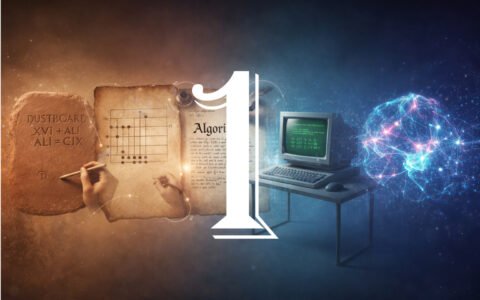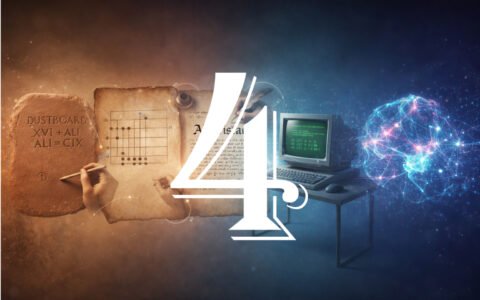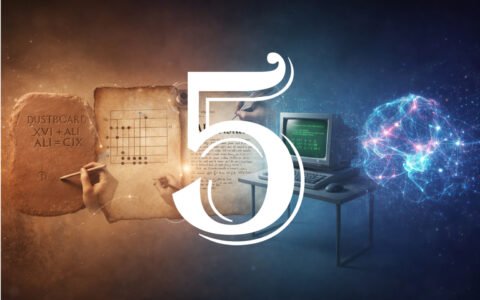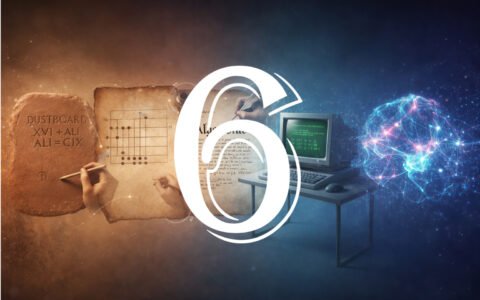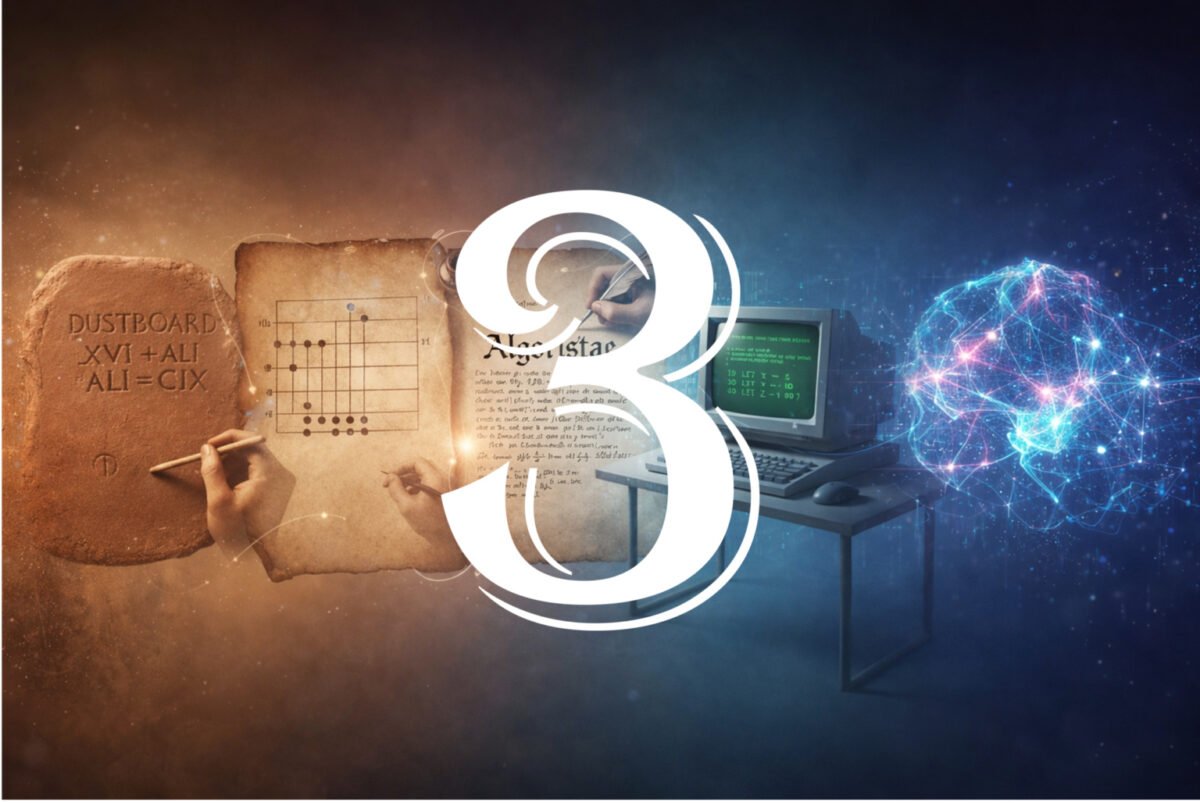
Thesis A examines whether the RAE’s (Real Academia Española) alternative derivation can be reconstructed – linguistically, culturally, and phonetically – so that it can serve as a serious explanation for the origin of algorismus/algorithmus.
Accordingly, the focus below is not on a personal name, but on a methodological term from Arabic:
- ḥisāb = reckoning / calculation
- ḥisāb al-ġubār = dust reckoning / calculation with (Western Arabic) numerals, i.e., on sand/dust boards or tablets
The possible intermediate term algobarismus, also mentioned by the RAE, is a “nice to have” – it is not a mandatory evidentiary anchor.
Two words or a proper name?
The crucial point is how one reads the word “algorizmi”:
- as a whole (like a proper name -> eponymic)
- as a hybrid of two parts (Algo(r) + izmi/ismi -> functional)
This yields three interpretive variants:
- purely eponymic: name = al-Ḫwārizmī
- mixed form: “art of calculation” + name ending
- purely functional: calculating practice + Latin “-ismus” (doctrine/method)
Because there is no “smoking gun” proof for any of the three variants, an evidence check is required: what supports which reading linguistically, historically, and phonetically?
Three-step reconstruction: from an ancient Egyptian root to medieval Latin
Thesis A is tested in three steps:
- Word history of “reckoning”: from the ancient Egyptian root ḥ-s-b (counting/calculating) to Arabic ḥisāb.
- Two calculating worlds in the Arabic sphere:
- ḥisāb al-hind (Indian calculation, place-value system)
- ḥisāb al-ġubār (dust/sand-board reckoning, gubār numerals, counting board)
- Toledo as a translation hybrid zone: in the 12th century, Arabic technical terms are “translated” into Latin within a multilingual practice – often orally, often phonetically, often as hybrids of specialist and everyday language.
The core term ḥisāb: calculation as method, not just counting
An important point: in Islamic scientific language, ḥisāb does not merely mean “to count,” but an arithmetical method. Even in the title of al-Ḫwārizmī’s algebra work, ḥisāb signals a methodological approach. This matters because it aligns semantically with a later Latin understanding of “doctrine/procedure.”
Two methods: hisāb al-hind vs. hisāb al-ġubār
Between the 9th and 12th centuries, two forms of reckoning coexist:
- al-hind: Indo-Arabic numerals + place-value system (stronger in the eastern Islamic world)
- al-ġubār: dust/sand board, counting board, Western Arabic gubār numerals (stronger in the Maghreb and al-Andalus)
And here the strategic point emerges: Toledo (the translators’ milieu) lies precisely in the region where al-ġubār is culturally plausible – and Toledo is also the environment in which “Dixit Algorizmi” is typically situated.
Toledo as a place of hybrid terms
In the 12th century, Toledo is Christian, yet culturally bilingual. Translation processes often work like this:
- an Arabic-speaking intermediary reads/explains in the vernacular
- a Latin-trained scholar renders it into Latin
- much happens orally, not as a clean text transfer
Just as hybrid terms arise in modern business (cloud storage, HR department), hybrid technical terms could arise in medieval trade and translation practice – efficient, pragmatic, and without any intention of honoring a scholar’s name.
A key indication: alguarismo in mercantile contexts
A central lever is evidence that in the Iberian world (14th century) alguarismo/alguarismus is attested in writing in the context of merchants and money changers – as a label for a calculating art closely related to counting-board/abacus practices.
This makes the RAE approach concrete: even if “algobarismus” as a bridging term is scarcely attested, alguarismo shows that an al-ġubār–adjacent sound form existed in everyday usage.
ḥisāb al-ġubār is older and anchored differently than the eponym suggests
Thesis A gathers several Western Arabic sources that present dust reckoning as an established calculating art – without reference to al-Ḫwārizmī:
- Said al-Andalusi (11th c.): mentions ḥisāb al-ġubār in al-Andalus and traces the method to an older tradition; notably: no link to al-Ḫwārizmī, but instead a narrative of an Indian (royal) origin.
- Abū Bakr al-Ḥaṣṣār (12th c.): a textbook on the “art of dust reckoning” (ṣanʿat ʿamal al-ghubār). The title reads semantically like “al-ġubār-ism”: practice + doctrine/method.
- Further voices (including Ibn al-Yāsamīn, Jacob ben Nissim) support the idea of a Western, method-centered understanding of ghubār reckoning as a widespread practice.
The upshot of this source landscape: in the Western Arabic–Andalusian sphere, ghubār is tightly tied to instrument and method – “dust” becomes the name of a calculating practice.
User logic: why merchants matter
This explains why a functional origin is plausible: in the Middle Ages, multiple calculating worlds coexist, and the choice depends strongly on audience and context:
- Abacus: physical, transparent, usable even for the illiterate (high trust)
- Dust board / line reckoning: flexible, fast, easy to document, but more vulnerable to manipulation
- Paper reckoning / rule-based algorism & algebra: efficient, but writing- and training-intensive (initially more of a scholarly tool)
Precisely because trade is pragmatic, a term like “al-ġubār + -ismus” (“doctrine/technique of dust reckoning”) could emerge without any need for a scholar’s name.
Phonetics as a stress test: g/k/ch fits ġubār better than Ḫwārizmī
A further argument concerns sound:
- The Arabic initial ḫ (as in Ḫwārazm/Ḫwārizmī) is a guttural consonant that medieval Latin does not cleanly render as g or ch/k.
- Many Latin variants of algorismus/algorizmi, however, begin precisely with g or with sounds close to ch/k.
This is not proof, but it is suggestive: the widespread Latin sound form fits al-ġubār strikingly well, and fits an initial Ḫ- less well.
Result of Thesis A: the light is green
Thesis A reaches the following interim conclusion:
- algorismus can be derived in a factually arguable way from ḥisāb al-ġubār.
- Western Arabic primary sources (including al-Andalusi and al-Ḥaṣṣār) support ḥisāb/ʿamal al-ghubār as a calculating art.
- alguarismo (merchant usage) makes a hypothetical “algobarismus” unnecessary – possible, but not required.
- Ambiguity is explainable: depending on users, “algorism” could mean sand-board reckoning, counting-board reckoning, or numeral-based reckoning.
- Phonetically, al-ġubār fits at least as well – arguably better – than the initial Ḫ- of al-Ḫwārizmī.
Accordingly, the traffic-light rating for Thesis A is green overall: plausible, documentable, coherent. This trail becomes truly compelling above all if it can be combined with Thesis B (medieval usage) and Thesis C (19th-century back-projection) into a closed overall picture.