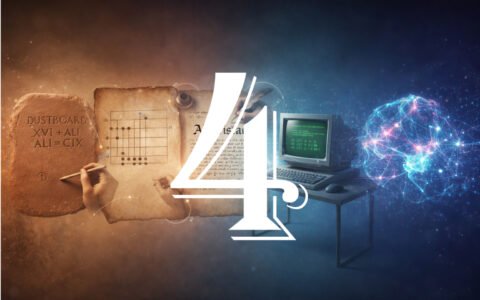
Why is it precisely Leonardo of Pisa (Fibonacci) who matters so much for interpreting the etymology of algorithm? Because he is the only medieval contemporary witness who left reliable statements about the term and its possible origin. He knew exactly what he was writing about. And he hadn’t “forgotten” anything.
Fibonacci is regarded today as one of the most important mathematicians of all time – someone who mastered not only mathematical theory but also its practical application as a merchant. What drove him in search of the best methods of calculation was not “art for art’s sake,” nor any theoretical ideal. Rather, it was operational, practical commercial usefulness that led him to praise a method – or to condemn it.
Algorithm as a mistake
And his judgment of the method of algorism – apparently common everywhere in his time – is secure: it was a mistake! Just like the arcs of Pythagoras. Only “Indian calculation” had a future.
That this is so, and not otherwise, follows from the introduction to his book Liber Abaci – about abacus calculation. There he, who had personally visited many countries of the Mediterranean world, sums up his knowledge of mathematics as practically as possible, with many examples that anyone can understand.
The obvious contradiction
What triggered the questioning of the al-Khwarizmi eponym was the obvious inconsistency in the text of arguably the most important witness of medieval mathematics. Leonardo Fibonacci was no isolated scholar; he was a world traveler, trained in North Africa, who mastered Arabic mathematics in all its nuances. Yet 19th-century historians claim that he “forgot” where the term algorithm comes from.
That is plainly speculative, illogical, and scarcely defensible:
- Detailed knowledge: In Chapter 15 of the Liber Abaci, Fibonacci uses precise terms such as algebra and almuchabala. He demonstrably uses examples from Abū Kāmil, who in turn explicitly refers to al-Khwarizmi. Fibonacci knew exactly who al-Khwarizmi was.
- The verdict: In his introduction, Fibonacci mentions algorismū (algorismus) in the same breath as the abacus and calls both “a mistake” (quasi errorem). Precisely because he knew that this was not meant to refer to al-Khwarizmi.
Why would the very man who celebrated Arabic algebra use the founder’s name as a label for an “erroneous method” – and at the same time forget whom he was citing? Systematically, that makes no sense at all. Explaining it away as “forgetting” borders on the ridiculous.
Competition and ranking
In the introduction, Fibonacci speaks of a “competition of calculating methods.” And as in a sporting event, he begins with the one in “third place” – out of only three contestants. And that is – drumroll – the algorithm! Clearly last out of three, because it is the most outdated. Who takes second place? The “arcs of Pythagoras” – meaning the calculating methods later associated with Pope Sylvester II and the abacus.
And who comes in first? Who wins Fibonacci’s gold medal among calculation methods? Algebra – Indian calculation in the tradition of al-Khwarizmi. And why does algebra win? Fibonacci explains that in detail in Chapter 15. And why does he do so? Because this method of calculation requires explanation; it is not self-explanatory.
What he explains – and what he does not
You only have to read the English translation of the Liber Abaci to see what Fibonacci explains – and what he does not. Let’s start with three words that could all have followed the same word-formation pattern:
- Algebra (from al-jabr): joining/restoring.
- Almuchabala (from al-muqabala): setting against/balancing.
- Algorism (from al-gubar + the Latin suffix -ismus): calculating in dust.
None of these three terms is a walkover even for today’s high-school graduates. Each needs explanation – especially in the Middle Ages, when few people could read and write. And the only term Fibonacci does not explain in detail in the Liber Abaci is the word algorithm/algorism. Yet the word appears right in the introduction.
Seriously: who would write a text for pragmatic merchants in which three foreign terms occur – one of them so alien on page one that it would normally put you off reading any further?
The “al-gubar” alternative
If you take Fibonacci’s text seriously, the thesis of the RAE (Real Academia Española) suddenly becomes the most plausible explanation: algorithm is not derived from a person but from “al-gubar” (Arabic for dust/sand). Even more importantly: almost every potential reader of his book would have known this. That is why he does not explain the word – because it did not need explaining.
- Systematics: Fibonacci uses a consistent word-formation pattern: al-jabr / algebra, al-muqabala / almuchabala, al-gubar / algorism.
- Context: “Dust calculation” (hisab al-gubar) was an operational marketplace technique.
For a visionary like Fibonacci, who wanted to introduce the precise “Indian method” on paper, this smearing in sand really was a lower stage – an “error” compared to the new science. In short: third place! And if he was supposed to have forgotten the link to al-Khwarizmi – who would ever have known it before him? No one!
A witness is rehabilitated
The point of analyzing the etymology of algorithm is less to present the RAE thesis as proven. But it is robust – and it resolves the almost embarrassing contradiction produced by traditional etymology.
The Middle Ages did not “forget” the alleged link between al-Khwarizmi and algorithm. Nor did Fibonacci “forget” it. Rather, as a comprehensively educated mathematician of his time, he used the term algorithm exactly as it was understood across the Mediterranean: for him it was the name of an inherited, artisanal practice that he wanted to replace with a future-oriented method of calculation:
Algebra – the actual teaching of al-Khwarizmi.