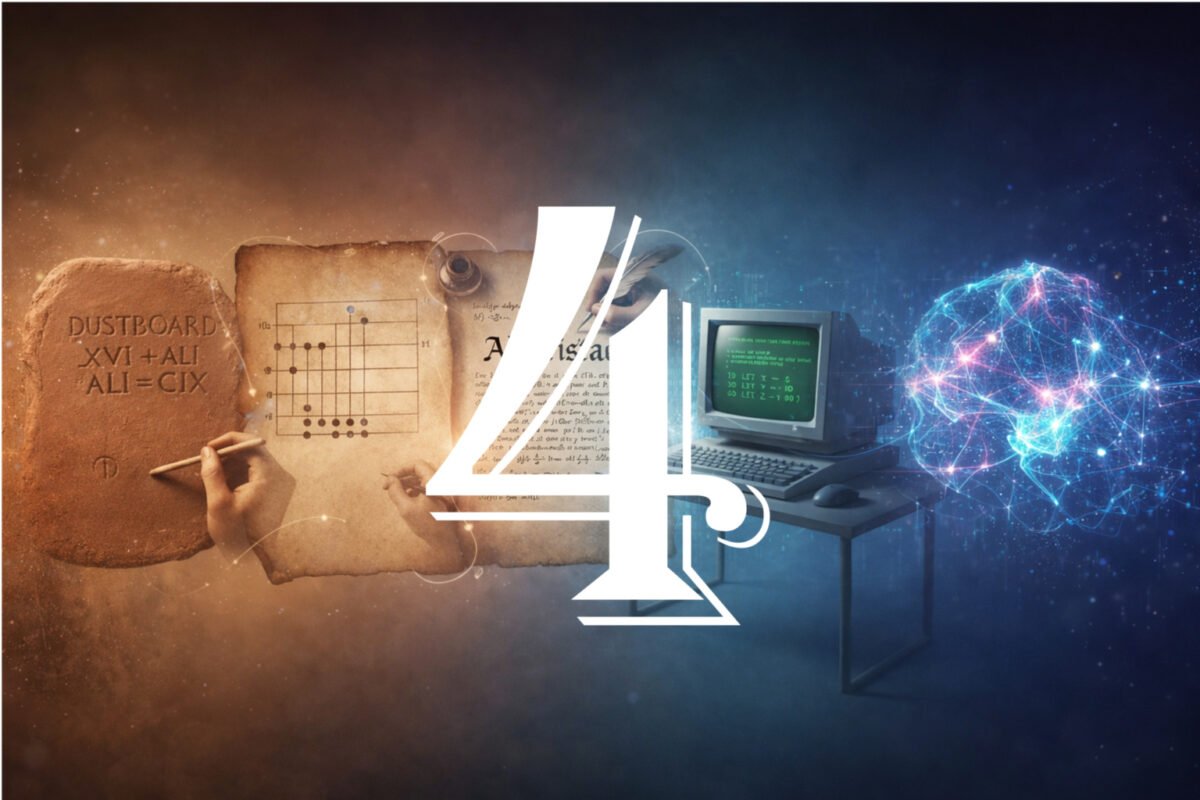
Thesis B tests whether the RAE idea from Thesis A can be found in medieval usage – i.e., whether algorismus/algorithmus in European primary sources is understood functionally (as a calculating art/method), and not as the personal name of al-Ḫwārizmī.
The benchmark is simple: what do the medieval texts themselves say – and what do they not say?
Key text: Fibonacci’s Liber abaci (1202/1228)
Leonardo of Pisa, better known as Fibonacci, is one of the most important witnesses. He knew many countries, virtually all the calculating methods common at the time, and the scholars behind them. He also promoted algebraic calculation in his Liber abaci. In doing so, he uses algorismum in a grammatically unambiguous way as a teaching term, not as a person.
Algorism as an “outdated” method – explicitly so
Most importantly, he evaluates algorism negatively:
“Algorism” is an error compared with the “method of the Indians” (Leonardo da Pisa/Fibonacci, Liber abaci, 1202)
This is central to the argument because it resolves a widespread misunderstanding:
Only if algorismus in Fibonacci does not mean “al-Ḫwārizmī’s Indian-numeral doctrine,” but rather the inherited, abacus-adjacent board/sand reckoning (al-ġubār / dust board), does his critique make sense. Otherwise it would be a bizarre “self-critique” of precisely the method associated with al-Ḫwārizmī that Fibonacci himself advocates.
The fact that he does not explain the term is also a strong indication
Fibonacci explains almost everything didactically. That he does not further define algorismus suggests that the term was self-explanatory for his target audience (Mediterranean merchants): a well-known practice he aims to supersede.
In short: for him, algorism functions as a common label for a widespread but, in Fibonacci’s view, outdated calculating practice.
Alexander de Villa Dei, Carmen de Algorismo (1200)
Almost contemporaneous with the Liber abaci, algorismus is also used positively in Europe – as a school and teaching text. The authors are primarily mathematically trained translators from the milieu of major translation schools. The key figure here is Alexander de Villa Dei, who wrote the so-called Carmen de Algorismo.
Its opening already defines algorism clearly as the art of reckoning (ars numerandi) with the “ten figures of the Indians.” That is a methodological, not a personalized, approach.
“King Algor” – naïve legend or a trace to al-Andalusi?
The poem nonetheless names a mythical “King Algor” as a possible origin of algorism. This was later often dismissed as “folk etymology.” The analysis suggests: this figure fits strikingly well with Said al-Andalusi’s (11th c.) narrative of an Indian “King of Wisdom” associated with dust reckoning (ḥisāb al-ġubār).
One further point is decisive: Villa Dei treats only the word-initial “Algor” as potentially name-like. The suffix -ismus is, for him, plainly “doctrine/method” – i.e., functional. Ultimately, he signals that not only the term but also its content may be explainable without reference to a specific person.
Sacrobosco, Algorismus vulgaris (1230)
Johannes de Sacrobosco turns algorism into a university teaching system for written arithmetic with basic operations, fractions, etc. The term is again understood as ars numerandi, and the addition vulgaris signals: “common/ordinary/practical.”
He offers multiple derivations
Sacrobosco presents several etymologies side by side (e.g., “art of number,” “introduction to number,” “Algo/Algus as inventor”). This reads less like a secure name derivation and more like didactic framing: algorism is primarily a method, while a mythical founder – again as in the Carmen – is mentioned in passing.
Again, Algo/Algus appears as a mythical originator – a name that phonetically does not fit al-Ḫwārizmī either. It does, however, once more fit Said al-Andalusi’s narrative. In the end, algorismus vulgaris likewise avoids tracing the term back to a real person.
Mercantile practice: Jacopo da Firenze (1307)
Jacopo translates and expands Sacrobosco – but for a different audience: practitioners, merchants, abacus students. He brings algorism, in Italian, into the world of interest, trade, and money, and links it to regional abacus traditions (including Provence).
This makes visible what Thesis B emphasizes overall: in the Middle Ages, algorismus could be understood both as “innovative calculating art” (scholarly) and as “practical board/line reckoning” (mercantile) without any personal name being required. And when a personal name is discussed, it is never al-Ḫwārizmī, but the philosopher-king Algo(r).
Iceland, Hauksbók (14th)
In Iceland as well, algorism appears as a generic term for a doctrine of calculation (Indo-Arabic place-value arithmetic). Notably, there is once again no attribution to al-Ḫwārizmī – although translators or compilers could easily have carried over such an attribution from Latin sources if it had already been established.
Balthasar Licht, Algorithmus linealis (1509)
With the printing press comes a striking title: “Algorithmus on lines” – i.e., explicitly line reckoning / counting-board logic (a 2D positional procedure). It is a method similar to ḥisāb al-ġubār, which persists long after Ibn al-Yāsamīn, Jacob ben Nissim, Abū Bakr al-Ḥaṣṣār, and Fibonacci.
The point is not only historical but semantic:
- even here, algorithmus remains functional – as a procedure, not a name;
- it serves as a transitional bridge: old practice (lines/board/coins) and new rule-based arithmetic (paper, place value).
What does the source comparison show?
Almost all texts support “algorism” as a calculating art – not as a personal name
Apart from the singular Dixit Algorizmi, the medieval evidence is strikingly consistent:
- algorism = art/teaching/rule system of calculation
- with shifting valuation (negative in Fibonacci, positive in teaching texts)
- often coupled to a counting board / dust board as a universal tool
Abacistae vs. algoristae: the term lives on as an “-ism” system
By the early modern period at the latest, abacistae and algoristae stand in opposition – precisely in the pattern of “doctrine” and “adherents.” That fits perfectly with an -ismus / -ista logic (a method term), not with a forgotten proper name.
What about Dixit Algorizmi?
Thesis B arrives at surprising, well-supported results that reinforce the functional reading:
- the text is singular, without an Arabic original, and the author/copyist is unknown;
- compared to secure algebra translations, it appears compilatory and multi-voiced (switching I/he), with glosses and mixed logics;
- Crossley/Henry (1990) show clearly that the copyist/assembler does not properly master “algorism” and mixes abacus procedures with newer rules.
Especially important: if the compilers did not even master algorism, why would they have named it after al-Ḫwārizmī? Could they have known his teaching at all? That is doubtful, particularly because the translation of al-Ḫwārizmī’s algebra occurred only after the creation of Dixit Algorizmi.
If “algorism” was already known in everyday practice as dust-board reckoning (al-ġubār), the internal contradictions of the Dixit dissolve: then “Algorizmi” is not a real person, but is most plausibly an allegorical speaking authority – as was common in the Middle Ages (“Dixit Venus,” “Dixit Iustitia,” etc.).
Result of Thesis B
Thesis B reaches a clear result:
- Plausibility: green (high)
- Documentability: green (high)
- Coherence: green (high)
Because:
- a medieval proof “Algorism = al-Ḫwārizmī” is consistently absent;
- by contrast, there is abundant evidence that algorismus was understood as a functional calculating practice, often linked to the dust board and the Western Arabic context (al-ġubār);
- the double meaning (older board/positional logic vs. newer place-value arithmetic) straightforwardly explains why the term could be both criticized (Fibonacci) and celebrated (school texts).
And this sets the stage for Thesis C: if medieval usage is so stably functional, the question becomes even sharper – when and why did the dominant eponym narrative arise at all?