The Dixit Algorizmi is regarded as the earliest verifiable written mention of the word “algorithm.” The Latin text from the 12th century is said to be based on an Arabic original by the mathematician Mohammed Ben Musa al-Hwarizmi. But is there any solid primary evidence for that at all? Or is it all just speculation?
The Latin text of the 12th century
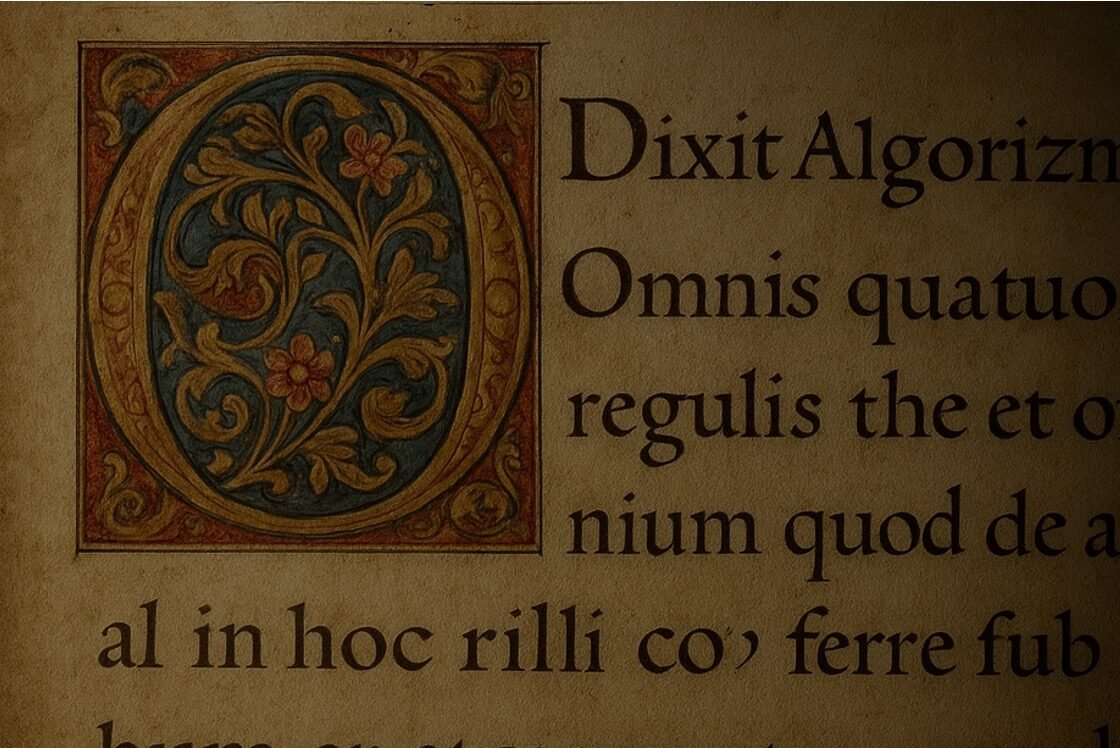
There is a Latin text from the early 12th century that begins with the words Dixit Algorizmi. Translated, this means roughly “Thus spoke Algorizmi.” A wording that creates the impression that the content of the text comes from a real person whose name is “Algorizmi.” And what this person supposedly said had a lasting impact on the world of mathematics. The imaginary figure introduces, among other things, the so-called decimal place-value system. Added to this are calculations with Indo-Arabic numerals and several other things. It is a text that has entered world history.
The many mysteries of the work
The text contains several mysteries that have occupied generations of historians of mathematics:
- Who was this Algorizmi?
- Was he an Arab scholar?
- Which Arab scholar?
But who was this man? We know that Al-Bīrūnī wrote a treatise on arithmetic and that he, too, bore the byname Al-Khwarizmi (Joseph Reinaud, 1849).
The first person who seemed to solve the riddle was the Frenchman Joseph Reinaud. In 1849 he wrote his Mémoire géographique, historique et scientifique sur l’Inde. In it he put forward a conjecture. The word Alchoarizam, which sounds similar to Algorizmi, could describe the Persian polymath Mohammed Ben Ahmad al-Biruni. But it could also be Mohammed Ben al-Hwarizmi. Both came from the region of Khwarezm, which sounds like Alchoarizam. This alone shows how uncertain the very first assumption was.
No problem, because Reinaud explicitly described it as mere conjecture. He provided no solid evidence that Alchoarizam described a region at all, let alone a real person. For the evidentiary value of his speculation, that was not necessary. Anyone who is clearly stating a conjecture does not have to prove anything. Even so, he set the idea in motion that today’s word “algorithm” might go back to the region of Khwarezm – there, in turn, possibly to the person of Mohammed Ben al-Hwarizmi as one of two options.
The use of the nominative algorizmus proves that the awareness that Algorizmus was the name of a man had already been lost by the author of the treatise (Moritz Cantor, 1865).
The “proofs” of Moritz Cantor & co.
From Reinaud’s conjecture there emerged, from 1865 onward, a wealth of “suggestions of proof.” Thus, the nominative in a newly rediscovered manuscript of the Salemer Codex supposedly “proves” that “Algorizmi” is a person. This allegedly also “proves” that the person’s name was “forgotten” throughout the entire Middle Ages. Only in the mid-19th century was “the truth” rediscovered – on the basis of scholarly knowledge at the time, which often rested on only a handful of manuscripts that were frequently dated incorrectly.
In view of this, Moritz Cantor was already a controversial historian of mathematics during his lifetime. Various texts were devoted to criticizing his working methods. In 1912, the Swedish mathematician Gustaf Eneström even published a piece on Cantor’s imprecise approach with the telling title:
How can the further spread of unreliable mathematical-historical statements be prevented (more on this here).
Against this background, is it a coincidence that in that same volume X of 1865 the orientalist Moritz Steinschneider confidently identifies the unknown person, in the Zeitschrift für Mathematik und Physik, as al-Hzwarimi? Without any solid evidence that there is an eponym at all, he immediately examines five scholars from the Khwarezm region. But only one is said to have already become known during his lifetime as al-Hzwarimi – again, a scarcely supportable claim.
The double-proof suggestion
Further “proofs” followed from Gottfried Friedlein and Peter Treutlein. All of them relied on medieval documents that had only just been found – among them some that they wrongly dated to the 12th century. In reality they come from the late 13th, perhaps even from the 14th century.

Image source: Cantor, Zeitschrift für Mathematik und Physik, Volume X, 1865
But that still was not enough: Cantor, Friedlein, and Treutlein constructed an interesting “double-proof model.” They assumed, unshakably, that Algorizmi described the person al-Hwarizmi. Therefore the Dixit Algorizmi had to be the translation of a lost original – a book that was never found and is also not mentioned in old texts such as the Fihrist or in the similarly extensive largest Arabic compendium by Haji Khalfa.
It is true that a book by “Algorizmi” on algebra is referred to. But it would be an Arabic original that to this day nobody knows which book could be meant. The solution: it is al-Hwarizmi’s work, but “lost.” The lost, unknown original in turn would confirm al-Hwarizmi’s authorship of the Dixit, because he is also demonstrably said to have written the first book on algebra. Logical, right?
No – quite the opposite! If not even the Fihrist and Haji Khalfa know this book, although both list al-Hwarizmi’s work along with all of his known books, then the missing “original” of the Dixit Algorizmi is a fixed idea.
The whole story here as a PDF: van-Helsing.ai – The Odyssey from Algorizmi to Algorithmus (166 pages, as of December 2025)
Three imaginary titles
From the mid-19th century onward, three imaginary Latin titles nevertheless emerged for the Dixit Algorizmi, which itself had no title. They gradually transferred onto the original whose existence was assumed – yet a work whose existence has still neither been confirmed nor found to this day.
- First, the title Algoritmi de numero Indorum by the Italian Baldessare Boncompagni from 1857.
- Cantor mentions another title in 1865: Incipit liber algorizmi.
- In 1978 Juan Vernet uses yet another title: De numero Indorum.
Each of these titles ultimately refers to the same Dixit, which had no title. All indirectly refer to the supposedly lost Arabic original on which the Dixit Algorizmi is said to have been based. Titles that never really existed nonetheless increase the suggestion that such an original must once have existed – even though to this day there is not a single primary proof of its existence or of its author. Add to this that the authors of the Dixit probably did not even know al-Hwarizmi. Why?
That the text is not a direct translation from Arabic is supported by the inclusion of glosses (Crossley/Henry, 1990).
Could the author have known al-Hwarizmi?
In 1990, John Crossley and Alan Henry examined the Dixit Algorizmi. In their extensive study they found something remarkable:
- Whoever wrote the text likely had no understanding of al-Hwarizmi’s algorithms. That, in turn, argues against well-known scholars such as Adelard of Bath, to whom the translation is attributed.
- Verbatim: “Finally, it is clear that the scribe was not familiar with the algorism and that the incorrect placement of part of the text, as well as the inherent difficulty of learning the new notation, may have made this particular manuscript less attractive.”
Overall, Crossley/Henry concluded that the manuscript was a kind of “patchwork.” It could not be based on just a single text. It consisted of several texts woven together with breaks in content.
But if there were several texts:
- Could there ever have been “the” original?
- The question is answered already by how it is phrased: “No!”
One has to ask: if the authors of the Dixit wove together multiple texts and did not even understand al-Hwarizmi’s algorism – how could they have given the text precisely the name of the scholar whose teachings they did not correctly understand?

Was there an original at all?
What is certain is that for more than 150 years countless scholars have assumed the existence of the Arabic original. But there is still no proof of it. The content of the Dixit Algorizmi is also demonstrably far too inconsistent and contradictory to be the translation of an original. It seems secure that multiple texts were processed and combined in this work. Finally, the Latin original still shows significant differences from the book that is truly known to be by al-Hwarizmi:
his book on algebra – the Hisab al-jabr wa-l-muqabala.
Given the many inconsistencies, van-Helsing.ai investigated the matter. Based on the analysis of more than 50 primary sources in online archives and the use of nine different AI systems, the conclusion is:
It is highly questionable that an original ever existed.
Instead, what emerges is a case of citogenesis – one that has been self-confirming for more than 150 years, asserting that an original must once have existed. As already mentioned: not even the Kitab al-Fihrist names the supposedly lost original. The oldest catalogue of Arabic textbooks up to the 10th century mentions only al-Hwarizmi’s algebra and several other texts – but none of them fit the Dixit Alogrizmi.
So where does the name “algorithm” come from?
To emphasize once again: to this day no original of the Dixit Algorizmi is known. The authors of the text likely did not even know al-Hwarizmi – nor his method of calculation, since they applied his teaching incorrectly. If that is true, then al-Hwarizmi is not the name-giver either.
So where does the word “algorithm” really come from?
There is a simple and surprisingly coherent answer. It has been maintained for more than 25 years by the Real Academia Española (RAE). Indeed, even in 18th-century lexicons it was already present. The word derives from the Western Arabic ḥisāb al-ġubār. In Old Spanish it was adopted as alguarismo or el guarismo.
This thesis is fully consistent with the negative assessment of algorism by the world-famous merchant Leonardo of Pisa (Fibonacci). Ultimately it was the merchants of the Mediterranean who, in the sense of a folk etymology, shaped the name. They used the term long before the Dixit Algorizmi was written. It was a word that had always described an abacus-like “art of calculation” and was transferred from (Western) Arabic into Latin.
And the original underlying the Dixit Algorizmi? It probably never existed!